
At PrivateEdPro.com, we’ve seen firsthand how families often assume that a private K-12 education is out of reach—only to discover that financial aid grants and scholarships for private schools k-12 can make an enormous difference. Through years of guiding parents across income levels, we’ve learned that the real challenge isn’t just the price tag—it’s understanding where to look, how to qualify, and when to apply.
That’s why this guide goes beyond the basics. Instead of repeating generic advice, we share practical strategies we’ve tested with families: how to interpret eligibility requirements, how to strengthen applications with overlooked details, and how to target merit-based opportunities that align with your child’s strengths. From uncovering lesser-known grant programs to navigating school-specific funding pools, our goal is to help you approach financial aid with confidence—and maximize every dollar of support available.
Top Takeaways
- Financial aid matters. Most families depend on financial aid grants and scholarships for private schools k-12.
- Eligibility is wide. Income, leadership, talents, and service all count.
- Apply early. Strong, on-time applications improve success.
- Stack aid sources. Combine need-based, merit, and local awards.
- Small awards add up. Even a few thousand dollars can make private school possible.
Table of Contents
Exploring Financial Aid Options
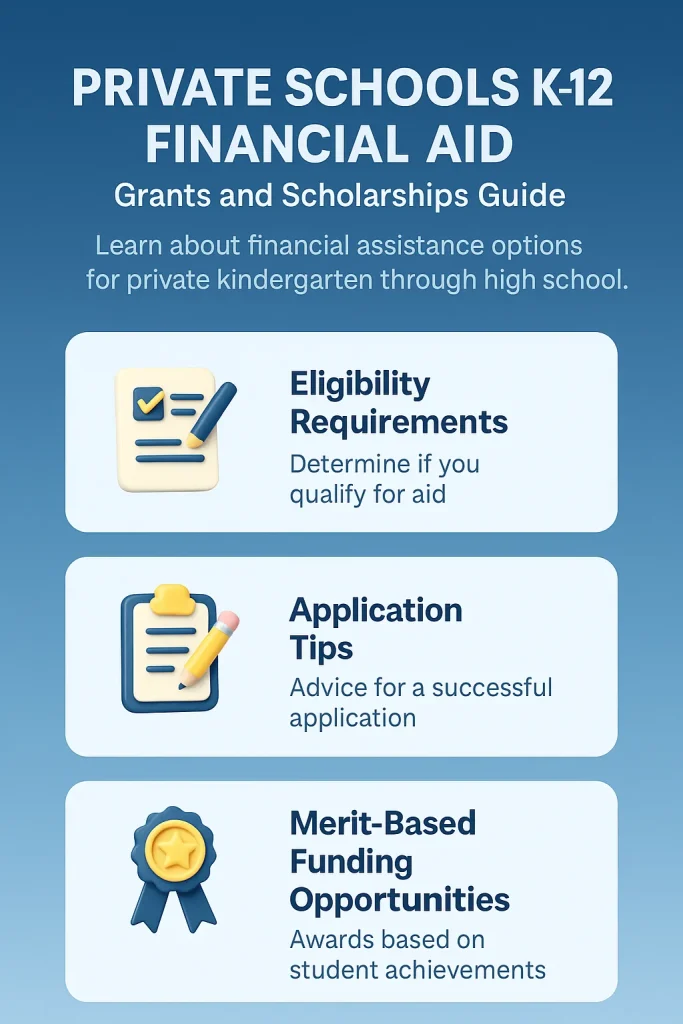
Paying for private K-12 education doesn’t have to be overwhelming—families have more options than they realize. Schools, nonprofit groups, and independent organizations offer financial aid grants and scholarships for private schools k-12, helping make tuition more manageable through need-based and merit-based programs.
Eligibility and Application Essentials
Eligibility often depends on family income, assets, and financial circumstances for need-based aid, while merit scholarships focus on a student’s academic achievements, leadership, or special talents. Preparing a strong application is key: gather financial documents early, submit forms on time, and highlight your child’s unique strengths with evidence like test scores, creative work, or community involvement.
Making Private School Achievable
By combining need-based assistance with merit-based opportunities, families can reduce tuition costs significantly. With the right preparation and strategy, private school can shift from feeling out of reach to becoming an achievable investment in your child’s future.
“In our experience at PrivateEdPro.com, the families who succeed in securing financial aid aren’t always the ones with the greatest need, but the ones who prepare early, ask the right questions, and highlight their child’s unique strengths. We’ve seen how a well-timed application and a thoughtfully presented story can unlock grants and scholarships that families never thought they’d qualify for—turning private education from a dream into a real, affordable opportunity.”
Case Study & Real-World Examples
From our work with families at PrivateEdPro.com, one insight stands out: the biggest savings usually come from combining multiple funding sources—not relying on a single scholarship.
Case Study 1: The Martinez Family
- Challenge: Two children applying to private schools; worried aid wouldn’t be enough.
- Key Strategy: Highlighted their oldest child’s leadership in community programs (not just grades).
- Outcome: Secured both need-based aid and a merit award.
- Result: Tuition costs reduced by nearly 60%.
Case Study 2: The Singh Family
- Challenge: Assumed only school-based aid was available.
- Key Strategy: Expanded their search to include local foundation scholarships.
- Outcome: Daughter’s STEM achievements and passion for robotics stood out.
- Result: Won a competitive award covering tuition and robotics program fees.
Lessons Learned
- Apply early. Deadlines matter—late submissions often miss out.
- Highlight more than grades. Leadership, talents, and community service can tip the scales.
- Think beyond the school. Local foundations and organizations often provide overlooked opportunities.
Supporting Statistics & Insights
At PrivateEdPro.com, we’ve seen how financial aid data reflects the real challenges families face.
- Billions in aid available. Independent schools awarded $3.6 billion in need-based aid in 2024–25 (National Association of Independent Schools).
Insight: Families who skip applying often miss life-changing opportunities. - Tuition costs keep rising. Median NAIS tuition doubled from $14,622 in 2004 to $31,088 in 2024 (Southern Association of Independent Schools).
Insight: We’ve seen this “affordability gap” firsthand—making layered aid strategies essential. - Even modest aid matters. Median award reductions average $3,353 per student (NAIS Facts at a Glance 2024–25).
Insight: From our experience, even a few thousand dollars can be the difference between “too expensive” and “within reach.”
Final Thought & Opinion
At PrivateEdPro.com, we know families often see tuition as a barrier—but financial aid is not a “last resort.” It’s a tool schools expect parents to use.
Key Insights from Our Experience
- Tuition rises, aid grows too. While costs climb, opportunities to offset them through financial aid grants and scholarships for private schools k-12 continue to expand.
- Layering is powerful. Families succeed when they combine need-based aid with merit awards and local funding.
- Preparation matters. Strong applications highlight more than grades—leadership, talents, and community service often tip the scales.
Our Opinion
- The biggest mistake is assuming you won’t qualify.
- The second is believing the process isn’t worth the effort.
- The truth: families who apply, prepare, and tell their child’s story are often surprised by how much support they receive.
Frequently Asked Questions
1. What types of financial aid are available for private schools K-12?
Families can access need-based grants, merit-based scholarships, tuition discounts, and state-funded programs in certain regions. Need-based aid depends on income and financial circumstances, while merit awards recognize achievements like academics, leadership, or the arts.
2. Who is eligible for financial aid grants and scholarships for private schools K-12?
Eligibility varies. Most need-based programs consider family income, assets, and number of children in school. Merit scholarships may look at test scores, extracurricular activities, or special talents. Even middle-income families often qualify for partial aid.
3. How do I apply for private school financial aid?
Most schools require families to complete a standardized application, such as the School and Student Services (SSS) form, along with tax documents. Others may have their own forms. Applications typically open in the fall and have deadlines in winter or early spring.
4. Can financial aid cover the full cost of tuition?
Yes, but it’s rare. Some students receive full-ride scholarships based on exceptional financial need or outstanding merit. More commonly, families receive partial aid that reduces tuition by 20–70%, often enough to make private schooling affordable.
5. Are there outside scholarships beyond what schools offer?
Yes. Local foundations, nonprofit organizations, and faith-based groups often provide independent scholarships for K-12 private schools. Some states also offer voucher programs or education savings accounts that subsidize tuition. Families should research both school-based and external opportunities.